Introduction
The manufacturing industry has experienced a remarkable transformation over the past few decades. From manual production methods to advanced automated factories, technology has continuously improved the way products are designed, created, and delivered. One of the most significant innovations driving this change is industrial robotics.
Industrial robots have become a key part of modern manufacturing by increasing productivity, improving accuracy, reducing costs, and enhancing workplace safety. With the advancement of artificial intelligence, machine learning, and automation technologies, robots are becoming smarter and more capable than ever before.
Today, industries around the world use robotic systems to perform tasks that were once completed entirely by human workers. From automobile production and electronics manufacturing to food processing and healthcare equipment, industrial robotics is reshaping the future of manufacturing.
This article explores the role of automation in modern manufacturing, the benefits of industrial robots, their applications, challenges, and future trends.
What Is Industrial Robotics?
Industrial robotics refers to the use of programmable robotic machines to perform manufacturing tasks automatically. These robots are designed to handle repetitive, complex, or dangerous operations with high speed and precision.
Unlike traditional machines, industrial robots can be programmed to perform different tasks and adjusted according to production requirements. They can work continuously with consistent quality, making them valuable tools for modern factories.
Common types of industrial robots include:
- Articulated Robots: Robots with multiple joints that provide flexible movement.
- SCARA Robots: Fast robots commonly used for assembly and packaging.
- Delta Robots: Lightweight robots used for high-speed picking and sorting.
- Cartesian Robots: Robots that move along fixed linear paths.
- Collaborative Robots (Cobots): Robots designed to work safely alongside humans.
These robotic systems are helping manufacturers create faster, safer, and more efficient production environments.
The Evolution of Automation in Manufacturing
Automation has been part of manufacturing for many years, but modern industrial robotics has taken automation to a completely new level.
During the early stages of industrialization, factories relied mainly on human labor and simple machines. The introduction of automated systems allowed manufacturers to increase production speed and reduce manual effort.
The development of computer-controlled robots in the late 20th century transformed manufacturing. Today, advanced robotics combined with artificial intelligence, sensors, and data analytics has created smart factories where machines can monitor, analyze, and improve production processes.
Modern automation focuses not only on replacing repetitive tasks but also on creating intelligent manufacturing systems that can adapt to changing demands.
How Industrial Robots Work
Industrial robots combine mechanical components, software, sensors, and control systems to perform manufacturing operations.
Robotic Hardware
The physical structure of an industrial robot includes arms, motors, joints, and tools that allow it to interact with materials and equipment.
Control Systems
Robots use computerized control systems to receive instructions and perform programmed movements accurately.
Sensors and Vision Technology
Modern robots use sensors and cameras to understand their environment. These technologies help robots detect objects, measure accuracy, and make adjustments during production.
Artificial Intelligence and Machine Learning
Advanced industrial robots use AI algorithms to analyze data, learn from experiences, and improve their performance over time.
Applications of Industrial Robotics in Manufacturing
Industrial robotics is used across many manufacturing sectors. Some of the most important applications include:
1. Automotive Manufacturing
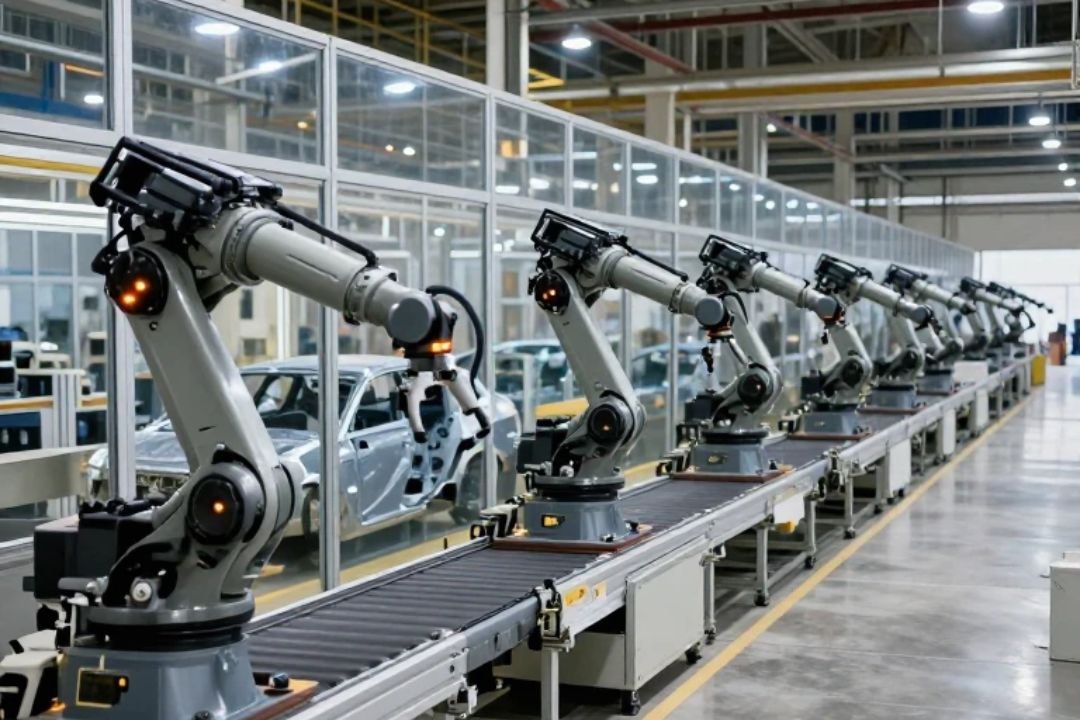
The automotive industry is one of the largest users of industrial robots. Robots are used for tasks such as welding, painting, assembly, and quality inspection.
Benefits in automotive manufacturing include:
- Faster vehicle production
- Improved welding accuracy
- Reduced manufacturing errors
- Enhanced worker safety
Robotic automation allows car manufacturers to produce high-quality vehicles efficiently and consistently.
2. Electronics Manufacturing
The electronics industry requires extremely precise production processes. Industrial robots help manufacture smartphones, computers, semiconductors, and other electronic devices.
Robots perform tasks such as:
- Component assembly
- Soldering
- Testing
- Packaging
Their high accuracy makes them ideal for handling small and sensitive electronic parts.
3. Food and Beverage Industry
Robotic automation has become increasingly common in food processing and packaging. Robots help improve hygiene, speed, and consistency.
Applications include:
- Sorting products
- Packaging food items
- Quality inspection
- Material handling
Automation allows companies to meet high production demands while maintaining safety standards.
4. Pharmaceutical Manufacturing
The pharmaceutical industry requires strict accuracy and cleanliness. Industrial robots help produce medicines and medical products with high precision.
Robotic applications include:
- Drug packaging
- Laboratory automation
- Material handling
- Quality control
Automation reduces contamination risks and improves production reliability.
5. Metal and Machinery Production
Industrial robots are widely used in metalworking industries for welding, cutting, drilling, and assembly.
Robots can perform dangerous tasks that involve extreme heat, heavy materials, or hazardous environments, improving workplace safety.
Benefits of Industrial Robotics
Industrial robotics provides many advantages for modern manufacturing.
1. Increased Productivity
Robots can operate continuously without fatigue, allowing factories to increase production levels and meet customer demands faster.
2. Improved Quality and Accuracy
Robotic systems perform tasks with consistent precision, reducing defects and improving product quality.
3. Enhanced Workplace Safety
Robots can handle dangerous jobs involving chemicals, heavy machinery, or extreme temperatures, reducing risks for human workers.
4. Reduced Production Costs
Although installing robots requires investment, automation can reduce long-term costs through improved efficiency and lower error rates.
5. Greater Flexibility
Modern robots can be reprogrammed for different tasks, allowing manufacturers to quickly adapt to market changes.
6. Better Data Collection
Smart robotic systems can collect production data and help companies analyze performance, identify problems, and optimize operations.
The Role of Artificial Intelligence in Industrial Robotics
Artificial intelligence is making industrial robots smarter and more adaptable. Traditional robots followed fixed instructions, but AI-powered robots can analyze information and make decisions.
AI improves industrial robotics through:
Predictive Maintenance
AI systems can monitor machine conditions and predict when maintenance is needed, reducing unexpected downtime.
Quality Inspection
Computer vision systems allow robots to identify defects and ensure products meet quality standards.
Adaptive Manufacturing
AI enables robots to adjust their actions based on changes in production environments.
Improved Collaboration
AI-powered collaborative robots can safely work with human employees and support complex manufacturing tasks.
Challenges of Industrial Robotics
Despite its many benefits, industrial robotics also faces several challenges.
High Initial Investment
Purchasing and installing robotic systems can be expensive, especially for small and medium-sized businesses.
Technical Complexity
Operating and maintaining advanced robotic systems requires skilled workers with knowledge of robotics, programming, and engineering.
Workforce Changes
Automation may reduce the need for certain repetitive jobs. However, it also creates new roles in robot programming, maintenance, and technology management.
Cybersecurity Risks
Connected robotic systems may face cybersecurity threats. Protecting industrial networks is essential as factories become more digital.
Integration Difficulties
Some companies may struggle to integrate robotic systems with existing manufacturing processes.
Future Trends of Industrial Robotics
The future of industrial robotics is expected to bring even more advanced automation technologies.
Smart Factories
Factories will increasingly use connected robots, artificial intelligence, and data analytics to create fully automated production environments.
Collaborative Robots
Cobots will become more common, allowing humans and robots to work together safely and efficiently.
Autonomous Mobile Robots
Mobile robots will improve warehouse operations, transportation, and material handling.
Advanced AI Integration
Future industrial robots will become more intelligent, capable of learning new tasks and adapting to changing conditions.
Sustainable Manufacturing
Robotics will help companies reduce waste, improve energy efficiency, and create more environmentally friendly production processes.
Conclusion
Industrial robotics has become a crucial part of modern manufacturing, transforming how products are designed, produced, and delivered. Through automation, robots are helping industries achieve higher productivity, better quality, improved safety, and reduced operational costs.
The integration of artificial intelligence, smart sensors, and advanced automation systems is creating the factories of the future. Although challenges such as high costs and workforce changes remain, the benefits of industrial robotics continue to drive global adoption.
As technology advances, industrial robots will play an even greater role in manufacturing. The future of production will not be based on humans or machines working separately, but on intelligent collaboration between people and advanced robotic systems.
